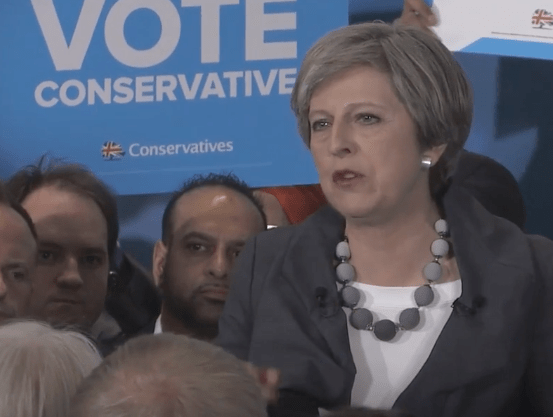
May’s campaign pledge to change human rights laws that “get in the way of” increased counter-terrorism efforts in response to pressure to act reveals a fundamental lack of understanding of the ECHR
Laila Sedgwick
Co-Editor-in-Chief
One week ago, in a campaign speech in Slough on the 6th of June, Prime Minister Theresa May made the following threat to dispense of the protection of human rights in the UK:
“We should have longer prison sentences for people convicted of terrorist offences.
We should make it easier for the authorities to deport foreign terror suspects to their own countries.
We should do even more to restrict the freedom and the movements of terrorist suspects when we have enough evidence to know they present a threat, but not enough evidence to prosecute them in full in court.
And if human rights laws get in the way of doing these things, we will change those laws to make sure we can do them.”
May has called for an extension of detention without trial to 28 days, a period singularly long amongst functional democracies (in the US the period is 48 hours). She wants to make it easier to detain and imprison suspects whose cases would not be accepted by a judge due to lack of evidence. She wants to remove a whole body of protection in a kneejerk reaction that may improve her popularity, but will ultimately do infinitely more harm than good.
Because human rights law doesn’t actually “get in the way” of counter-terrorism measures. May’s pledges are a lazy and ignorant response to a problem caused more by failed policy – vast reduction of funding to the police during the six years May was in the Home Office, the 20,000 police officers that have been cut under the Conservatives since 2010 and planned cuts of 10 – 40 % in London over the next four years – than by laws protecting human rights.
These laws can be derogated from when there is justification for doing so, when individuals are – demonstrably – dangerous. It is not difficult or uncommon to obtain permission to do so. This is how we deport people. The powers held by the police and security services to watch, search, detain and imprison terrorist suspects are not limited by human rights law. They are comprehensive: inciting violence is criminal, terrorist suspects can be searched without warrant and any suspect convicted of planning an attack can be imprisoned for life. May could enact effective counter-terrorism acts within the framework of international standards if she so desired. Instead, she is scoring cheap points by gambling with a whole body of protection whose importance is consistently forgotten and dismissed.
But a politician threatening to rip up human rights that stand in her way as a response to pressure to “crack down on” terrorism is not just lazy; it is reckless and dangerous. The rights in question – those protected by the European Convention of Human Rights – do not exist to be manipulated as a political tool in hard times. They exist to protect us all, to protect democracy and freedom, and ensure that the state can never infringe upon the basic rights we are all owed simply because we are human. Rights such as those to liberty, a fair trial and freedom from discrimination. Rights that were agreed in 1949, after the Holocaust, to prevent populist states wielding arbitrary power from arising in Europe ever again.
Incidentally: the rights protected by the Convention are a comprehensive list of the values terrorist groups abhor and hope to destroy, and in compromising them for her own political gain, May is playing straight into their hands.
Her statements seem to be driven by a prevalent idea, not discouraged by May and her government, that the Convention is yet another example of a set of unfair regulations being imposed on us by the EU, or by its continental members, and that it constitutes a nuisance to the UK. In fact, the reverse is true.
The Convention was produced by the Council of Europe, a body totally distinct from the European Union that was set up after the end of the Second World War to protect democracy, the rule of law and human rights. It was drafted mainly by British lawyers (notably David Maxwell-Fyfe, lawyer and Conservative MP who had just been prosecutor at the Nuremberg trials) and strongly advocated by Winston Churchill. The United Kingdom was the first of the twelve signatories to sign the Convention, and insisted that the rights it protected should not only be listed, but also clearly defined.
This is not a document that has been forced on us unwillingly. It is one that we fought for and constructed, that enshrines the fundamental principles of our constitution. Threats to dispense of it should not be taken lightly.


 The Amnesty
Leave a reply to akismetuser740209509 Cancel reply